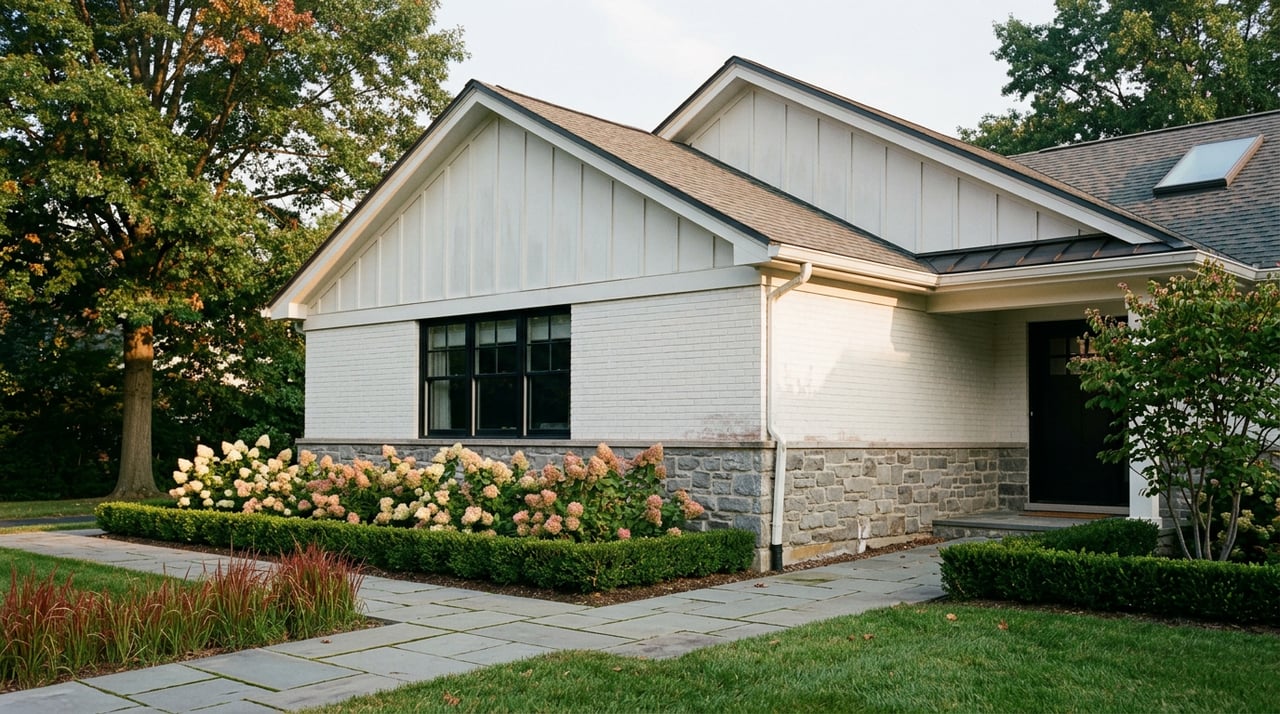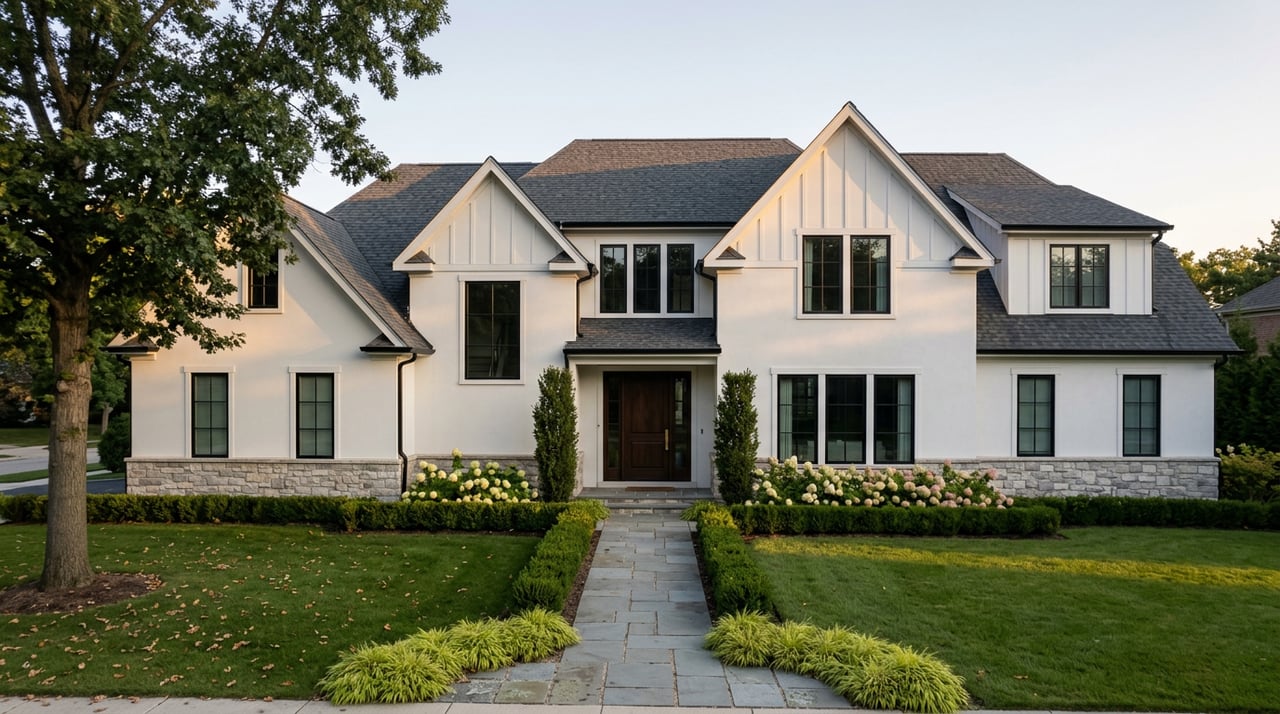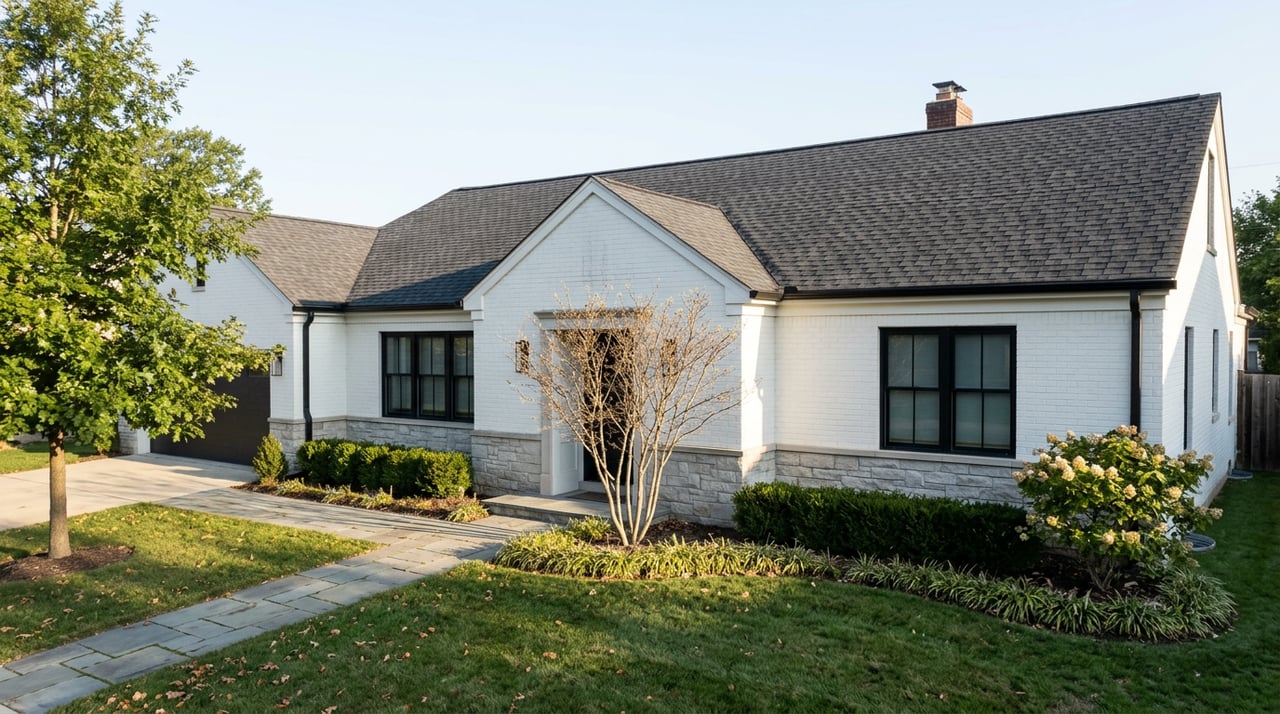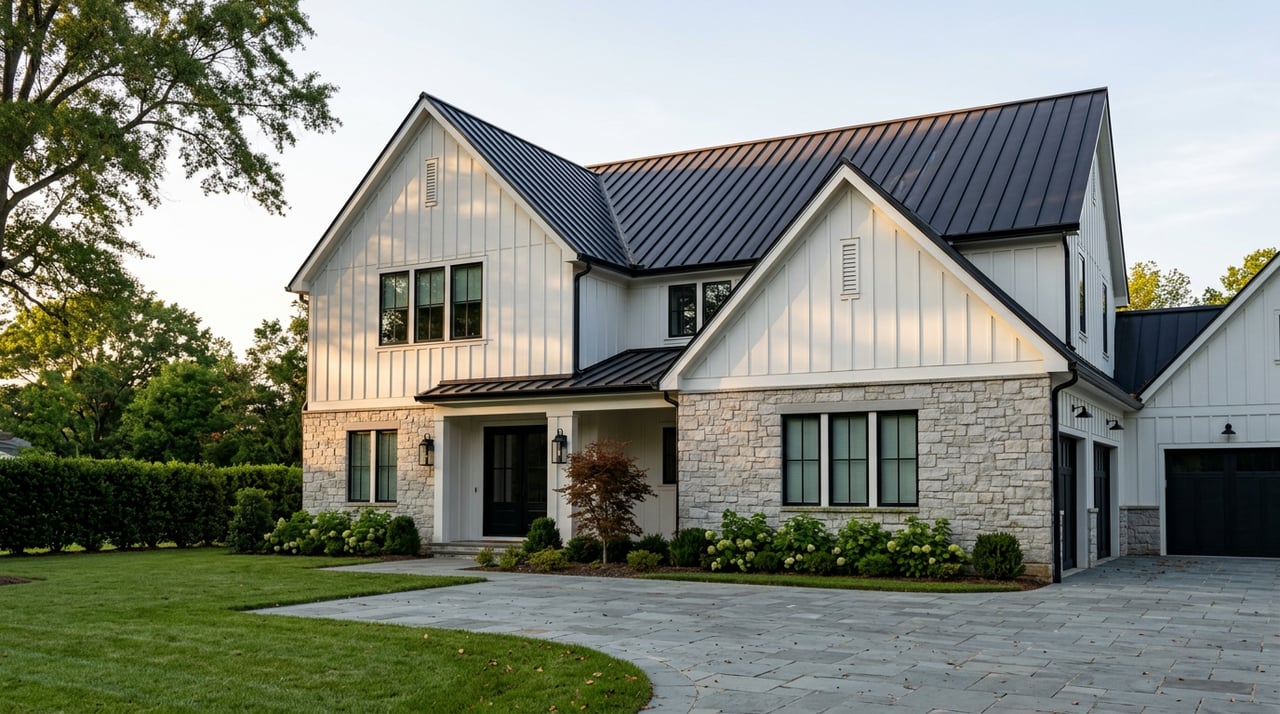
Two listings, both currently on the market in Great Falls. One is a fully renovated home with 4,000 finished square feet on a private, tree-lined two-acre lot, no HOA. The other is a new-construction project underway on Springvale Road, built by local builder Big Builders, delivering in late 2027 with roughly 9,000 finished square feet. Pull the price per square foot on each and set the numbers side by side, and you'd assume one is a steal and the other is priced for a very different buyer.
In most subdivisions, that read would hold up. In Great Falls, it usually doesn't, because both homes are answering to the same zoning math before either one answers to a buyer's spreadsheet.
A Lot Size Almost Nobody Notices They're Paying For
Most of Great Falls sits in Fairfax County's R-E, or Residential-Estate, zoning district. The conventional lot minimum there is 75,000 square feet, which works out to roughly 1.72 acres, with front setbacks of 50 feet, side setbacks of 20 feet, and rear setbacks of 25 feet. That floor shows up constantly in current land listings. A buildable 1.74-acre parcel near that exact threshold recently listed for under a million dollars, sold as raw land with approved plans ready for a builder to execute. A separate 2.4-acre homesite on Jeffery Lane, at 104,492 square feet, sits comfortably above the floor and is being marketed the same way, as dirt first, house second.
That detail matters more than it sounds like it should. In a typical suburban subdivision, lot sizes vary widely from one listing to the next, so price per square foot mostly reflects differences in the house. In Great Falls, a large share of the resale and new-construction inventory sits at or near that same 1.72-acre baseline, with plenty climbing into the two-to-five-acre range beyond it. That means the land under two very different homes can be closer in size, and closer in underlying cost, than the finished houses sitting on top of it.
The Arithmetic That Explains the Spread
Local price-per-square-foot figures for 2026 range from roughly $350 to $600, depending on finish level, lot characteristics, and location. That range looks enormous until you follow the arithmetic through.
If two homes sit on land that costs roughly the same amount, and if total project pricing for each lands somewhere in that broad range because buyers are paying for the whole package rather than the house in isolation, then stretching a similar total price over 4,000 finished square feet produces one number, and stretching a similar total over 9,000 finished square feet produces a very different one. The ground underneath barely changed. The denominator did.
You can see this mechanism already working its way into the aggregate numbers. Over the three months ending May 2026, the median sale price in Great Falls climbed to $1.9 million, up 23.1 percent from the same period the year before. Over that same window, the median price per square foot actually slipped to $369, down 2.1 percent. Total prices went up. Price per square foot went down. The likeliest explanation is that the homes selling during that window trended larger, which is exactly what you'd expect on lots built to a fairly consistent zoning floor: builders and renovators add square footage rather than acreage, because the acreage is largely fixed by ordinance, not by ambition.
Separate September 2026 listing data put the median asking price at $2.19 million and the median asking price per square foot at $372, a reminder that list-side and sold-side numbers rarely tell an identical story in a market this thin. The metric depends on which stage of the transaction you're measuring, and in Great Falls it depends just as much on which lot you're standing on.
Why Colvin Run Doesn't Price Like Georgetown Pike
A fixed zoning floor doesn't mean uniform pricing behavior. Great Falls is generally read across five recognized pockets, and each carries its own dynamics for reasons that have nothing to do with lot minimums:
- Colvin Run trades on proximity to walkable convenience, including a short stretch of restaurants, shops, and a bakery that most of Great Falls doesn't have within walking distance.
- Seneca, including the Seneca Gate community off Seneca Road, offers generous lots, but utility access varies parcel to parcel in ways that change what a buyer is actually purchasing.
- Great Falls Village carries a location premium tied to the shops and restaurants clustered at the Village Centre, a premium that has nothing to do with square footage.
- Georgetown Pike commands its own pricing behavior built on scenic frontage and a mix of historic and architecturally distinctive custom estates.
- River Bend Road leans on privacy, with larger and more secluded parcels than much of the rest of the community.
The Seneca Gate example is worth sitting with. One recent one-acre listing there marketed public water and public sewer as a distinct, rare feature, since most of its immediate neighbors and much of Great Falls broadly rely on private wells and onsite septic systems. That single infrastructure difference can move the effective value of comparable square footage more than a kitchen renovation would, because it changes the ongoing cost and maintenance profile a buyer is underwriting, even though price per square foot never shows it directly. Two homes with identical psf numbers can represent very different long-term obligations if one sits on public utilities and the other depends on a well and a septic field.
At the far end of this same mechanism sits Domaine de Rêve, a 14-acre estate compound developed by The Building Group, assembled from multiple estate parcels into a single legacy holding. It's an extreme version of the same math playing out at scale: land priced and positioned first, structure layered on second.
What to Actually Compare When the Numbers Don't Line Up
For a buyer trying to make sense of Great Falls listings, the fix isn't to abandon price per square foot. It's to change what you hold constant before you use it.
- Start with the lot, not the house. Check whether the parcel sits near the 1.72-acre zoning floor or well above it. That single number tells you more about the land cost baseline than the finish photos do.
- Ask the utility question early. Public water and sewer versus private well and septic changes ongoing cost and risk in ways psf doesn't capture. Two nearly identical numbers can represent two different ownership experiences.
- Compare within a lot-size band and a sub-area, not across them. A Colvin Run resale and a Georgetown Pike estate are not the same product even when their square footage overlaps.
- Treat new construction differently from resale. A spec project like the one underway on Springvale Road prices in current construction costs layered onto a comparatively fixed piece of dirt, while a resale home has already absorbed decades of prior finish decisions, appreciation, and depreciation.
None of this makes price per square foot a bad number. It makes it a number that only means something once you've matched the lot underneath it.
Reading lot lines and construction scope alongside closed comps is exactly the kind of comparison that benefits from having spent time on the building side of a project, not just the closing table. That's the lens Charisse McElroy and the team at REP Real Estate Partners bring to Great Falls listings, informed by in-house design and construction experience as much as by market data.
A Few Questions Worth Asking Before You Compare Two Listings
Does a bigger lot always mean a lower price per square foot in Great Falls? Not automatically. It depends on how much house sits on that lot and what condition it's in. A larger lot with a smaller, dated home can still post a higher psf than a similarly sized lot carrying a much larger new build.
Is price per square foot a useless comparison tool here? No, but it only holds up within a similar lot-size band and sub-area. Comparing psf across dramatically different lot sizes, or between a well-and-septic property and one on public utilities, compares two different products under one shared metric.
Why did the median sale price rise in 2026 while price per square foot fell? Because the homes selling during that window trended larger. When square footage grows faster than total price, the price-per-square-foot math falls even as the total transaction price climbs, which is exactly what shows up in the three months ending May 2026.
If you're weighing two Great Falls listings and the psf numbers aren't telling a coherent story, that's usually a sign the comparison needs a different denominator, not a sign the market is being irrational. Request a Concierge Consultation with REP Real Estate Partners to walk through what a specific lot, its utilities, and its structure are actually telling you about value.